


Non classé, VLOG
Complete Guide to Hajj Preparation for Muslim Women
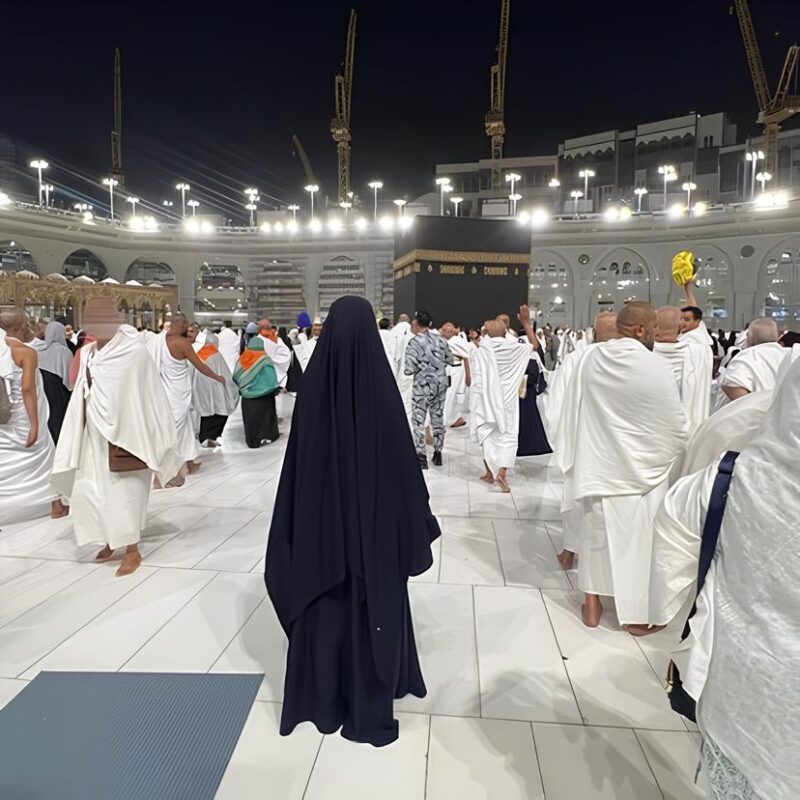
May
It was narrated from Aisha (may Allah be pleased with her) that she said:
“O Messenger of Allah, is jihad obligatory upon women?”
The Prophet ﷺ said:
“Yes. Upon them is a jihad in which there is no fighting: Hajj and ‘Umrah.”
Narrated by Ibn Majah in his Sunan (no. 2901) and authenticated as sahih by Al-Albani in Sahih Ibn Majah.
Hajj is the journey of a lifetime. A unique moment when the heart detaches itself from everything to turn entirely toward Allah. Every year, millions of believers answer this call and perhaps you too, my sister, are among those preparing for it today.
For Muslim women, this pilgrimage is an experience that is both spiritually and physically intense. Between the rituals to perform, the fatigue, the crowds, and all the organisation required, proper preparation is essential in order to experience this moment with peace of mind.
In this article, I will guide you step by step to help you prepare for your Hajj in the best possible conditions: mentally, physically, and practically, while also sharing concrete advice, especially regarding the choice of your outfits.
Preparing Mentally
Before even thinking about packing, the very first preparation is the preparation of the heart. The most important point to always keep in mind is your intention. Your intention for this journey should be solely devoted to seeking the satisfaction of Allah, as the acceptance of your pilgrimage depends on it.
The second essential point is patience. Indeed, my sister, you must prepare yourself both physically and mentally for the fatigue, the crowds, and the unexpected situations. Hajj is not a journey like any other; it is a true effort, more or less demanding depending on each person’s circumstances.
It was narrated from Abu Hurairah (may Allah be pleased with him) that the Prophet ﷺ said:
“Allah has not granted a servant anything better and more comprehensive than patience.”
Narrated by Al-Hakim and authenticated by Al-Albani in Sahih At-Targhib (no. 3396).
Although Allah has made its organisation easier in our time, Hajj gathers millions of people from different backgrounds, traditions, and cultures, all brought together in the same place at the same time.
Be patient with the shortcomings of your sisters in Allah, even if living alongside people who are different from you is not always easy. You are in a state of ihram: remind yourself of this constantly. Regularly renew your intention in order to calm your heart, accept unexpected situations, remain patient through difficulties, and give meaning to every step you take.
“And be patient, for indeed Allah does not allow the reward of those who do good to be lost.”
— Qur’an, 11:115
Learning the Rituals to Perform Them Correctly
The Prophet ﷺ said:
“Learn your rites from me.”
Narrated by Muslim ibn al-Hajjaj in Sahih Muslim.
It is essential, my sister, to learn about and understand all the rituals, obligations, and prohibitions before performing Hajj, as the validity of your pilgrimage depends on it. Proper knowledge helps prevent mistakes by ensuring full adherence to the rules described in the Qur’an and the Sunnah, while staying as far as possible from any form of innovation.
Reminder of the Pillars and Obligations of Hajj
- Whoever neglects a pillar of Hajj or Umrah, their Hajj or Umrah becomes invalid.
- Whoever neglects an obligation, their Hajj remains valid but must be compensated by a sacrifice that is performed and distributed in Makkah.
The Pillars of Hajj |
|
|
|
|
The Obligations of Hajj |
1.Entering into the state of ihram at the Miqat. |
2. Remaining at ‘Arafat until sunset. |
3. Spending the night at Muzdalifah. |
4. Stoning the Jamrat al-‘Aqabah on the day of Eid, and the three Jamarat during the days of Tashriq (11th, 12th, and possibly the 13th of Dhul-Hijjah). |
5.Shaving the head or cutting the hair. |
6. Spending the nights of the 11th and 12th, and possibly the 13th of Dhul-Hijjah in Mina. |
7. The farewell tawaf (Tawaf al-Wada‘). |
8. (Only for those performing Hajj Tamattu‘ or Qiran) Offering a sacrifice on the day of Eid or on the 11th, 12th, or 13th, or fasting three days during the pilgrimage and seven days after returning home, making a total of ten days.
|
Preparing Physically
As you have probably understood, my sister, you must prepare yourself for a journey that can be particularly physically demanding. Do not stress excessively though, it remains completely manageable if you know what to expect and prepare properly.
The first thing to know is that you will walk a lot. Chafing between the thighs, fatigue, and blisters may occur if you are not well prepared. As much as possible, try to get used to walking before your departure and make sure you are in the best physical condition possible. Also, plan to bring good shoes that are both comfortable and durable enough for long periods of walking.
If you live in Europe, you should also expect changes in your diet. Do not take unnecessary risks: if you are prone to digestive issues, take the necessary precautions before and during the trip.
Another essential point is that you should prepare yourself to sleep very little, especially during the first few days. Try to optimise your rest whenever possible in order to avoid adding extra fatigue to your journey.
What Should You Pack in Your Suitcase?
Discover a complete checklist of essentials to pack in your suitcase for Hajj.
Among the things you pack in your suitcase, one of the most important will be the choice of outfits you bring for this journey.
Choosing Your Outfits for Hajj: Between Modesty, Comfort, and Practicality
Contrary to some common misconceptions, women do not have a specific uniform like the male ihram. A woman simply has to wear clothing that complies with the principles of the legislated hijab. For maximum comfort, choose loose, lightweight, and fluid garments made from breathable fabrics (Whool Peach Premium will be your best friend). You should also plan several outfit options, as you are likely to sweat a lot.
👉 Advice: It is better to choose outfits in darker and neutral colours, especially black, which is particularly suited to the customs in Saudi Arabia.
Two main options are available to you:
The Essential Abaya
It is one of the safest and most common choices among female pilgrims from all around the world. Simple, practical, and covering, it allows you to dress quickly and stay comfortable throughout every stage of Hajj, provided that you choose a suitable model.
Choose an abaya that is loose and fluid, made from a breathable fabric, and designed with comfortable sleeves to make movement easier.
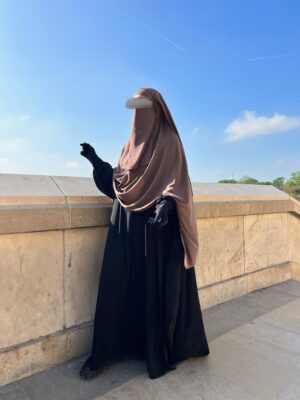
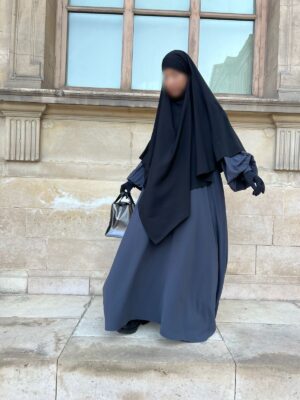
Models such as the Sleeve Abaya or the Bubble Abaya are perfectly suited thanks to their cuts, designed to provide complete comfort in daily wear.
A Skirt Set
Less traditional but very practical, the long skirt set is ideal for lightness and ease of movement.
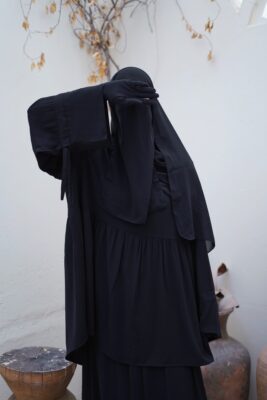
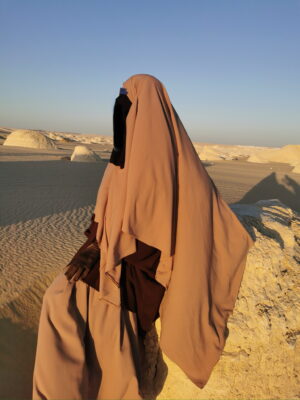
Flared skirts provide excellent comfort, especially during long walks. Paired with a loose tunic, they allow good airflow and great freedom of movement.
– Discover a wide selection of suitable sets.
–
Hijab, Khimar & Niqab
As for the veil, you may of course choose either a khimar or a hijab, depending on your habits and what you feel most comfortable wearing. You can go for the classic abaya × khimar combination, which is especially popular among European female pilgrims, or choose a maxi hijab paired with your abaya or your set.
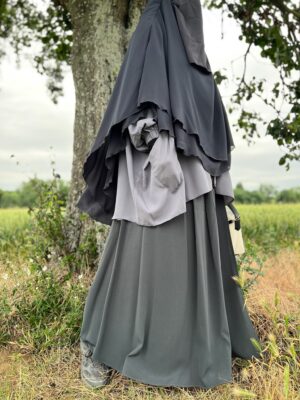
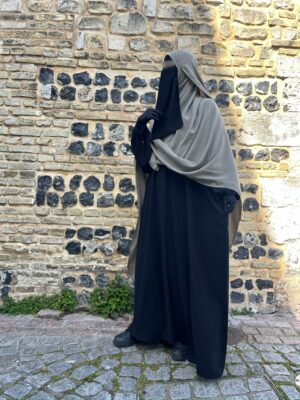
– Discover a wide range of Khimars & Hijabs. –
Pair a black abaya with a black hijab and a Saudi-style black niqab if you wish to resemble as closely as possible the outfits most commonly worn by the sisters in Arabia.
However, while in the state of ihram, wearing the niqab is prohibited. A suitable alternative is to choose a flared three-layer khimar with a sitar option, which allows you to lower a light veil over the face without going against this prohibition.
Another option is to attach a hijab to the top of your head using a small safety pin in order to cover your face during the state of ihram.
The Prophet ﷺ said:
“An accepted Hajj has no reward except Paradise.”
So prepare for the immense blessing that this journey represents with sincerity and humility, and cherish every moment as it should be, with patience and serenity.
Discover complete and suitable outfits on Oummi Abi Moi
